Friday, September 26, 2014

More Math Resources

Friday, September 26, 2014

We are working with the math committee again today, trying to get ready for the PARCC assessment that is coming in March.  We think we finally have a good sequence of lessons and activities that will hopefully prepare our students for this assessment.

Before we talk about some of our activities we did this week, we want to tell you about two math resources you may be interested in checking out.  Many of you may be familiar with the math site TenMarks, but our first time using it was this summer with our tutoring students. Students can go to the site and practice various math concepts.  The problems/lessons are challenging, but the students love them.  This site is a fabulous supplement to what you are already teaching.  We are planning on incorporating it into our daily math block.


Another resource that we just looked at today is called Georgia Common Core Standards.  It seems very user friendly, hands-on and engaging.  We are supplementing some of our math curriculum with these lessons.  We are really excited to implement them.


Two weeks ago we talked about the strategy of synthesizing.  This week we took that concept a bit further through science and writing.  As an extension to our study of polymers, the students created and tested a new question about the statement Polymers absorb liquid.  Some of the questions included: What would happen if the polymer was put in Coke?  What would happen if the polymer was put in chlorinated water?  What would happen if the polymer was put in colored water?  From this we drew the conclusion that polymers absorb liquids that contain water.  The more water the liquid contains the bigger the polymer grew.  

Polymer nose in chlorine.

Polymer hand in colored water.


We then wanted them to take this knowledge and apply it to answer the question: How can polymers make our lives better?  Again they did a great job of coming up with more ways polymers could be used in the real world than we could ever have imagined.

Synthesis


Our reading has focused on poetry and devices poets use when writing poems.  The students are having a great time finding these devices in the poems they read.  To help solidify some of these devices we made flip books.  Each page included a device word and an example of that device.  During Daily 5 the students read a variety of poems and then wrote a poem review.  They used their flip books to complete the review sheet.  These lessons are leading us into reading and analyzing narrative poems.


Our writing went along with our mini poem study.  The students wrote autobiography poems.  After editing them, they published them in Pages and used Photo Booth to import a funny picture of themselves.  As they hang in the hallway, many people have stopped by to enjoy.

Have a wonder weekend.  We are off to the reading conference next week.  Hopefully we will have some fun ideas to share.

Kim and Anne


Friday, September 19, 2014

A Crazy Week

Friday, September 19, 2014

Well it was crazy week!  We had two days of MAP testing, picture day, a CAP program, and a day of working on the math committee.  Needless to say we are in the middle of everything, and have nothing to show yet.

But, we do have a great math and language arts resource to share with you.  We learned about this resource through our math committee work.   It is a website called Engage New York.  This is a curriculum written by teachers that correlates to the PARCC assessment.  It looks challenging, but fantastic.  We are going to try Module One in math in two weeks.  We will let you know how it goes.

Next week we hope to share our writing and science experiment with you, and maybe a few more things if we get them done.  

We hope you have a great weekend.

Kim and Anne

Friday, September 12, 2014

Synthesizing!

September 12, 2014

Well, the week started off a little shaky, but it ended with a bang, thanks to all of the wonderful things we learned from the Smekens Retreat last June.

Each day, we have introduced a reading strategy that good readers use, as suggested by Kristina Smekens. It has worked out beautifully! We have one more strategy to go, but today was our favorite so far!

We started with the question, What do you do when you want to bake a cake? We used props to show the connection between baking a cake and synthesizing information while you read. Then, we introduced synthesizing through a poster, and a song.


Then, came the fun part! We had asked students to bring in a bottle of Snapple. We were going to have a Snapple party! The lids of the bottles have unique facts. We wanted the students to synthesize some of these unique facts with their background knowledge. We were so pleased with the conversations the students had!


After that, we handed each student a page from the book, 101 Hidden Animals by Melvin and Gilda Berger. We had the students read the page, and try to notice new thoughts they had about the animal on their page.


The last part of today was synthesizing with the science activity we did last week. It was perfect! To give you a little background, our school theme this year is Growing a Madison Mindset. We have been learning about our brain, and how important it is to have a growth mindset. To illustrate this abstract topic with our students, we used another great Steve Spangler activity called Growing Body Parts. We placed a small polymer brain in water and continued to measure its growth for seven days. We were amazed at how it grew so large! Then, we took it out of the water, and continued measuring. It shrank.
So the challenge for the students was to synthesize these two ideas. We knew it was going to be hard, and they would have to persevere, and they did! What a great way to end the week!


We are looking forward to a restful weekend and a great next week!

Kim and Anne

Friday, August 29, 2014

First Week Back

Friday, August 29, 2014

Well we made it through our first week of school.  It was great to see some of our returning second graders now in our third grade classroom.  The beginning of the year is always slow because we are establishing classroom routines.  As much as this drives us nuts, we know how critical it is to have an effective classroom where our students can eventually run the room.  However, we did do a few fun things.

Last week we mentioned that we were going to be trying an infographic project with the kids so they could share information about their summer vacation.  We weren't sure how successful this project would be because it was our first stab at it.  The kids loved it, and we were pleasantly surprised at the success of it.  We were amazed at their creativity and how they organized their information.  There were infographics arranged sequentially, web-like, cyclical, most favorite to least favorite, and in a flow chart.  We will definitely revisit infographics throughout the year, most likely varying the medium through which the information will be conveyed.


Our buzzing is up and running.  The kids loved getting into small groups to talk about the books they read at home last night.  We know this program will motivate our students to read more books.  In fact, even today students were eager to read a book they heard about from someone else.  From the get-go we want the students to know that reading is thinking.  We began our chart and kept their task simple for today.  They needed to discuss their favorite part of the book, explain why it was their favorite part (which is the real thinking part), and show it.


Another new activity we tried this year was a Would You Rather game, in place of our People Search, to get to know each other.  We found a picture book on Amazon called Would You Rather by John Burningham.  It was hysterical.  Then the kids played the game.  We found it on Teachers Pay Teachers.


We look forward to another fun-filled week after a much needed holiday weekend.  Happy Labor Day!

Kim and Anne

Sunday, August 24, 2014

First Week Fun

Sunday, August 24, 2014

Well, my classroom has been cleaned, rearranged and decorated!  I just have the finishing touches to add like name tags on desks, numbers on writing folders, and hooking up my Smart Board.  What a crazy couple of weeks it has been getting ready for school.  This is my 22nd time opening up my classroom for the start of the school year, and I still forget how much time it takes to make my learning environment just right for the students.

I can hardly wait to see my students who will be returning to my classroom as third graders, as well as meet my new third-grader students.

Building a classroom community, as you all know, is critical to having an effective, pleasant, and successful year.  So, I thought I'd share a few of the ways I plan to help my students get acquainted or reacquainted with one another during our first few days of school.

I found a great poem on the "Sunny Days In Second Grade" blog that I thought I would use this year as a little "Meet the Teacher" gift for my third graders.  This sweet, little poem can also be found on teacherspayteachers. It is called Ready Confetti.  I retyped the poem on fancy paper and stapled a jewelry bag filled with sequins to it.  I will have this on their desks during Meet the Teacher on Tuesday, so they can take it home and hopefully have a peaceful night's sleep.
Notice my typo!  I now need to change Sunday to Tuesday.  Always making more work for myself.  :)
I'm going to use Steve Spangler's Energy Sticks for our first team building activity.  It was one of the cool activities I engaged in when I was at his Science in the Rockies retreat this past July.  I plan to hand out an energy stick to each group of four students.  I'm going to ask them to figure out how the energy stick works.  Then I will encourage them to begin asking new questions about it, such as... Can two groups make one energy stick work?  Can three?  Can we make two or three energy sticks work at the same time?  How can we stop the energy sticks from working?

After we've exhausted and tested our questions, I will connect this activity to how our classroom community works.  I will remind them that the energy stick lit up and buzzed and worked effectively when everyone was connected.  It was fun to watch and be a part of.  When just one person stopped touching the energy stick it stopped working.  This is how our classroom works.  When everyone participates and is involved in our discussions and work we have fun, we work better, and we learn more.  When even one person stops working, for whatever reason, we don't have as much fun, our work is not better, and we are not learning as much.  In the coming days this activity will be a spring board for making our classroom rules, talking about how we treat one another, becoming mindful of our behavior, and just helping us create a caring, safe environment.

The second team-building activity I plan to have my students do also comes from the science retreat.  I'm going to use Wind Bags from SteveSpangler Science.  I'm going to let my students try to discover how to blow up the wind bags--there's a trick to doing so.  Then, after each student has had a chance to blow one up and tie it off they will separate into 2 groups.  Each group will be charged with the task of making the highest, free-standing structure possible.  The key will be to work together and cooperate.  When we teachers did this at the retreat it was so much fun not only to make the structure, but to see the creative ways other groups made theirs.  In addition to working together, this activity will allow students to get ideas from the other group and realize we can learn from each other.  Hopefully this lesson will transfer to other lessons and group work throughout the year.


The wind bags are a Sick Science activity, which means you can watch a video showing how to blow up the bags.


After attending Kristina Smekens' Literacy Retreat in June, I've been intrigued by students recomposing their knowledge in a variety of formats.  So after reading two articles on infographics that came across my blog feed, I knew I wanted my students create one right away.  These visual creations look easier to make than they are.  The creator must think about the information she wants to convey to the reader and then decide how to do so in a visual way.  Color, shape, spacing, size, and design are all very important to the finished product.  I thought a great, non-threatening introduction to infographics would be to have my kids view student-examples of infographics, and then create their own 3-D clay infographic depicting their summers. This is a brand-new activity for me so I will let you know how it goes.

I tried to make a flow chart with my favorite activity being the largest to my fourth favorite being much smaller.
This is supposed to show my time in Colorado, seeing a friend I haven't seen since high school, dog sitting, and running and reading.


Hopefully these activities will be a hit with my students.  I'll let you know next weekend.  We start school on Wednesday.  Have a great start to the school year.

Kim and Anne


Saturday, August 9, 2014

Perseverance

Saturday, August 9, 2014

Wow! Two weeks from Monday I start school.  I cannot believe it.  Yesterday afternoon was the first day we could get back into our classrooms and begin cleaning and setting them up for the start of the year.  That's not a lot of time, so today's blog is going to be short, but don't let that fool you because the topic can mean the difference between finally understanding a concept or not.


Persevere.  According to dictionary.com persevere is a verb which means to persist in anything undertaken; maintain a purpose in spiteof difficulty, obstacles, or discouragement; continue steadfastly. Persevere is also part of the first Mathematical Practice standards of the Common Core.  


Encouraging students to persevere in a mathematical problem or any type of creative activity is important because it causes them to figure out obstacles and overcome them.  It allows them, through trial and error sometimes, to come to a solution on their own.  It also allows students to take ownership over a task and gain a sense of accomplishment and empowerment.

Perseverance in math is what I worked on with two of my tutoring students this week.  I don't have anything cute or fun to show you in the typical sense, but I can say the feeling my students and I had at the end of the sessions were ones of success and pride.  So that was fun and the smiles on their faces were definitely cute.

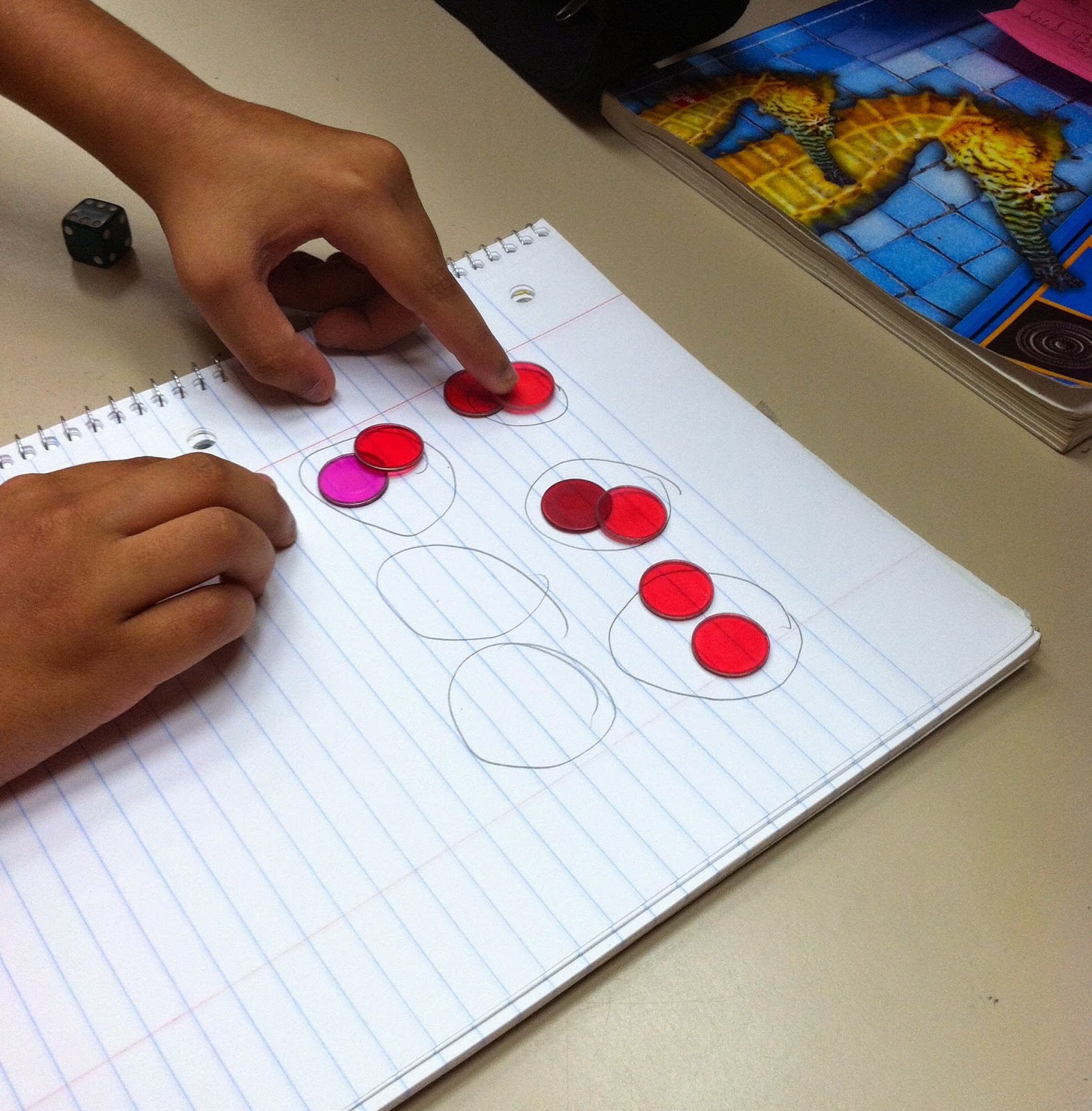
My third grade student is working on division.  We were playing a game called Egg Nest.  In this game, the student chooses between 8-32 eggs (counters) and then rolls a die to determine the number of nests (squares) to be drawn.  The eggs are then equally divided into the nests and any leftovers are put next to the group of nests.  In the picture below, Puneet chose 9 eggs and rolled a 6 for 6 nests.  He started putting 2 eggs in each nest and realized he was left with 2 empty nests and 1 egg.  He was stumped.  He really did not know what to do. I asked him questions that made him think about how he could solve the problem.  It took Puneet several attempts at solutions before he came up with the correct one.  He first put one egg in each nest and said to put the extras back in the bag.  Then he started over, dividing the eggs again.  Finally, he realized he could just leave the extras to the side and include them in the equation.

Then we moved on to try and solve division equations on a program called TenMarks.

He didn't know what to do with the one left over.


Persevering in solving division problems with counters.  Trying to determine how many counters to begin with and how to equally divide them.  Learning that being organized is helpful.

Next, I went over some other problems that he got incorrect on his TenMarks assessment.  Again, we looked at the problem, and he reworked it and saw where he went wrong.  That was powerful learning!


As stated in CCSS, part of perseverance is making sense of the problem.  We needed to determine which words were important and what the meant.


The problem with encouraging students to persevere is of course the time element we as teachers all struggle with.  It takes students, and any of us for that matter, time to struggle through a problem and find a solution.  It takes time to figure out where we went wrong and how to find a correct answer or solution. Sometimes, unfortunately, I feel the pressure to move onto the next activity so I "help" students discover the answers or the solutions.  This takes away some of their ownership. My goal this year is to try to allow for more time for to persevere because I truly believe that is where real learning takes place. 

Here is a link to an excellent video that shows a fifth grade teacher engaging her students in a fun activity while challenging them to persevere in solving the problem as a group.  This was the first video I ever watched on perseverance and where I realized how fun, yet powerful it can be.

I hope everyone has a great start to the school year.  I may not be blogging next week.  All depends on how much work I get accomplished in my room.  Until we blog again.

Kim and Anne

Saturday, August 2, 2014

Math Resources and More

Saturday, August 2, 2014

Wow, I can't believe it's already August.  Doesn't it seem like summer just flew by?  I want to take a moment to show you a little reading and hands-on activity I did with one of my third-grade tutoring students this past week.  As I mentioned previously, he is completely enthralled with World War II.  I posted a cool World War II website on the blog last week, and I used one of the activities from it last Tuesday.

We read a section from the site called "The Blitz".  It told about air raids (which my student had tons of background knowledge about), blackouts, and gas masks.   The site is interactive so we were able to click on different photographs and read about them, too.  It kept him very engaged.  But, we had the most fun when we read the directions on how to make a gas mask and then made one!  My student said it was the coolest thing he had ever made.  That made me smile!


My friend and colleague, Margaret, is moving from teaching 5th grade to teaching 8th grade next year.  I told her about this site, and she is going to check it out and see if she can use it with her students.  So, if any of you have friends or colleagues who teach World War II tell them about this site.

The rest of the week I worked with my other tutoring students on math.  With the third graders, I have been using resources from Interactive Sites For Education, Map Practice by RIT, K-5 Math Teaching Resources from a Common Core Newsletter, and logic puzzles by Aims Education.  The Interactive Sites allowed my students to use games to practice multiplication and division facts. We are going to begin the year with multiplication problem-solving so they need a good head start on memorizing their facts.  Map Practice by RIT gave them some practice with algebra, which was pretty cool. 


The Common Core Resources had one and two-step word problems for my students to solve.  The two-step problems are tricky and they need lots of practice with them so they can be ready for the really complex problem-solving we are going to be doing in third grade. This site also has games to play and literature that can be used to teach math concepts.  Next week I'm going to use Six Dinner Sid.
Sample story problems.


Here is a problem one girl solved.  First we underlined and discussed what each of the numbers meant.  Then, she drew a picture to solve the problem.  After, we wrote an equation to match what she did in the picture.


The logic puzzles by Aims Education were fun.  They require students to use deductive reasoning skill and to think more flexibly in order to solve them.


These are two of the logic puzzles I chose to use with my students.


With my fifth-grade student I used some YouTube videos to review how to find percentages.  A game at MathPlayground helped her review algebra, as did Bracket Basics.  Both of these sites were a hit with her!

We did Algebra Puzzle.  Very fun!


Another resource I want to share with you is one I found late last spring.  It's called Music for Management. Since I found this so late in the school year I did not use the music ideas with my students, but I plan to this year. The TV Theme Song link looks really good.  It looks like it helps manage transition times, talkative students, wrap up times and more.  From what I've read, it seems like playing music works magic!


When you are at the home page, click on Music Central on the right to get here.


Finally, just this morning, I found a great site called 53 Ways To Check For Understanding.  I love resources like this because it keeps me fresh in the interactive activities I ask my students to do to  demonstrate their understanding.  I especially want to try numbers 17, 18, 19, 20 and 21.  These seem like fun and engaging activities that allow students to recompose their knowledge.  I talked about the importance of that last week.


I hope you find these resources helpful as you begin to think about your new school year.

Kim and Anne