Saturday, February 23, 2013

February 23, 2013

We had another whirlwind of a week.  We hit the ground running by finishing our guided reading Reports in a Can.  This came about after reading several non-fiction articles on various animals.  To recap, we charted facts we learned, responses we had, and new questions that we wondered about during our guided reading sessions.  Then it was time for the fun.  We looked through our notes and found ideas that went together.  We circled those ideas in different colors.  Then each student wrote paragraphs on index cards using that information.  They did this for two or three topics.  Finally they illustrated a title strip to wrap around their cans.


Then, all the reading groups got together to share their different reports. It was an amazing celebration, because everyone was so proud of their writing. We really felt their writing flourished in the small group setting because students were able to bounce writing ideas off of each other. They wanted to know what sounded write, or what words they could use to make their writing better.

Though it was sad to leave Anansi, we were excited to begin a new theme in reading-biographies! Once again, we shared our students. For this shared reading, both groups read the same story as an introduction to biographies, but the pacing and activities were different. Our follow-up reading will also be differentiated.

We began this unit by asking students the question: What is a biography? Many hands went up, and children shared their correct understandings of what a biography is. One new feature that we introduced was the structure of a biography. The students loved learning the new word chronological order.

Then, it was time for pre-reading activities. One group's pre-reading activity included watching a video about George Washington Carver. Then, we read and discussed the story, A Weed Is a Flower: The Life of George Washington Carver by Aliki. While we read, we charted important facts from his childhood, young adult life, and adult life. Next week, we will use these notes to create a thumbnail sketch about George Washington Carver.

The other group's pre-reading activity was to try to sequence George Washington Carver's important life events into a timeline before reading the same story, A Weed Is a Flower: The Life of George Washington Carver by Aliki. They taped on the events in the order that they predicted was correct. During shared reading, they noticed timeline events that needed to be changed. They will make those changes when they revisit their timeline after the reading. This group also charted important facts. Next week, they will use the same note taking organizer when they read biographies of important Americans of their own choice. They will also be doing a fun project that we will be sharing with you next week.


As promised from last week, here are a few more of our animal reports that were turned into text pages. We are so proud of their work!  


Here is one picture of an animal report turned into a nonfiction page.  Click here for a full slide show of more reports. Animal Report Slide Show

Have a great week.  We look forward to sharing more ideas next week.  We would love to hear your comments and ideas.  We are always looking for more fun and effective ways to teach reading and writing.

Kim and Anne

Saturday, February 16, 2013


February 16, 2013


This week has been a writing marathon, or so it seemed. To start the week, and to get ready for Valentine's Day, we used Cara Carroll's Love, Splat writing idea. After reading the book, students wrote about when they feel loved, and then made their own Splat character. We think they are adorable. You can find this idea at her Teachers Pay Teachers store. Here's the link: Love, Splat


Once that was finished, we went back to working on our animal reports. The students had been writing the body of theirs reports. They focused on adding details, voice, and fluent sentences to their writing. They've come along way since September. We were very impressed that they could take their notes and turn them into interesting texts.

The last part of writing these reports was to add the lead. We know from experience that writing the lead is one of the  most challenging parts of this type of writing. Therefore, to support our students, we taught this skill through mini-lessons. After practicing this skill they added leads to their reports. The mini-lessons involved explicitly teaching them four types of leads: Single Word, Listen-Up, I Wonder, and Imagine That. These leads were taken from Ruth Culham's book, 6+1 Traits of Writing. To make this abstract skill more concrete, we used a picture of a lion and created an example of each lead to go with the picture. Then, we gave groups of students pictures of frogs and asked them to work together to create one of each type of lead. We shared some of their leads and charted them. This chart hangs in the room for students to refer to during Writing Workshop. They relied on these models when writing the lead to their animal reports. As a follow-up to this mini-lesson, we then gave students a picture with the four different types of leads. They had to identify what type of lead each one was.


Here are some of our students' leads from their animal reports:

Single Word Lead
I Wonder Lead

Imagine That Lead


We are now in the process of publishing! Instead of publishing their reports in traditional paragraph form, we wanted the students to apply what they have learned about nonfiction text features. We used Pages Newsletters and let students add their favorite nonfiction text features. Some highlighted important words, some used headings, and some added captions to their pictures and maps. Only a few are finished with this project because they are so engaged with this lesson, they don't want to stop and be finished! Here are two finished reports. We'll share more next week.


To wrap things up this week, we wanted to share our finished Meaningful Quotes from Anansi project. Success, finally!!! Here is the link to our Anansi lesson plan.Teachers Pay Teachers


Have a great long weekend! We hope you can use some of our ideas.

Kim and Anne


Saturday, February 9, 2013

February 9, 2013

Friday was our 100th day of school! We can hardly believe how quickly this year is flying by.  As promised in our last blog, we want to share with you some of our Anansi activities from the week.

We began reading aloud Anansi and the Moss-Covered Rock.  We focused on the strategy of questioning.  We stopped reading at various points in the story so students could ask questions, while we recorded them on paper.  During this time, we also modeled thicker questions in hopes some of the students would do the same. Naturally, and thank goodness, our students also applied other reading strategies such as predicting and inferring.  After completing the story, we analyzed our questions, and tried to decide which questions were thin and which ones were thick.


The next day, at read aloud time, we showed the students the cover of Anansi and the Magic Stick.  They all cheered.  This happens every year; Anansi is a favorite character.  That day our purpose for reading was to begin analyzing Anansi as a character.  This is going to prepare them for our culminating activity where they have to write an extended response to the question, "Would you want Anansi as a friend?"  After reading, we created a character web of Anansi.  The kids had no problem coming up with plenty of descriptive traits.


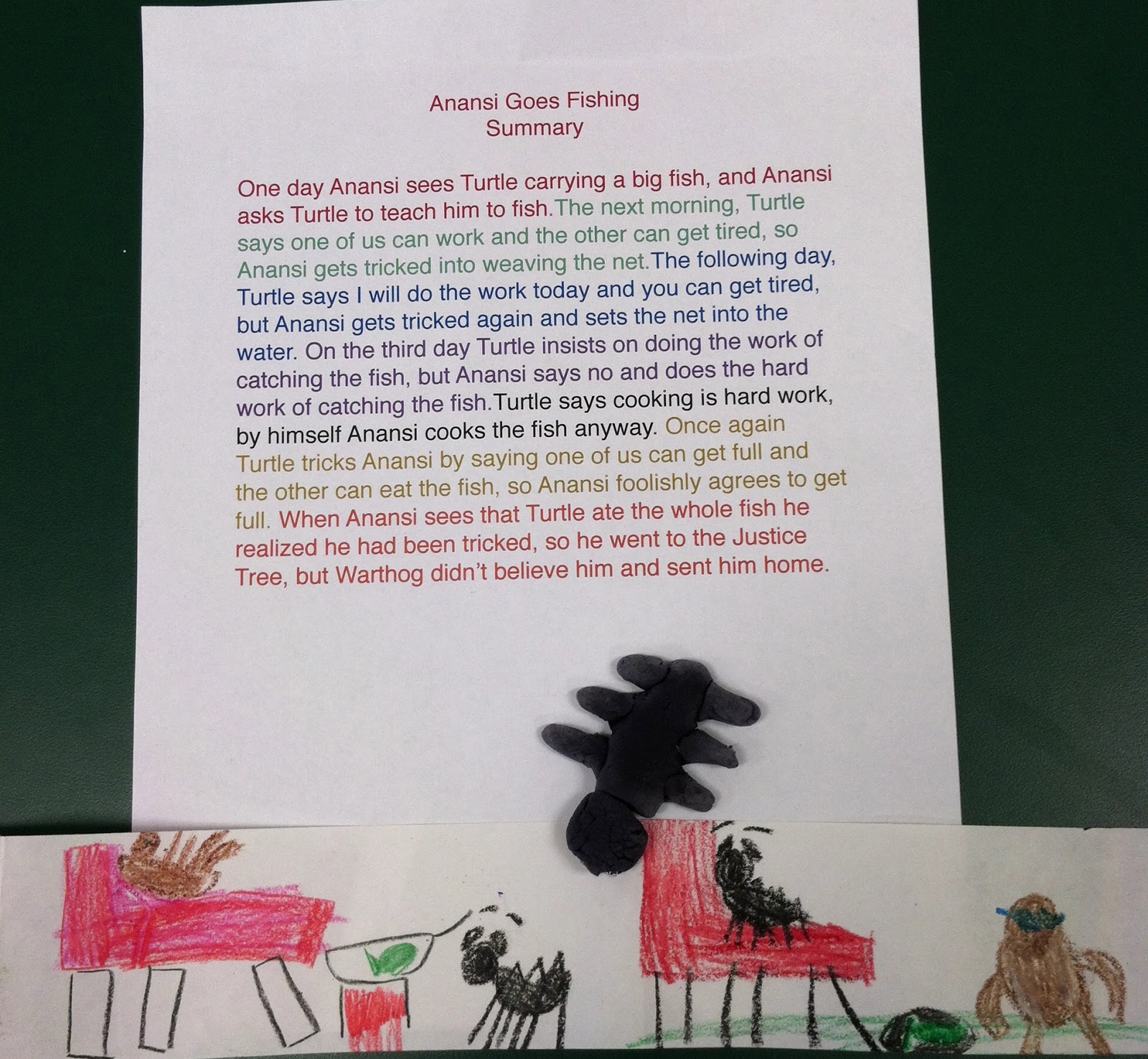
That same day, during shared reading, we read Anansi Goes Fishing.  Boy this was a tough story for the kids to comprehend because of the play on words.  We really had to read those first two pages closely so the kids really understood what Turtle was saying and how he twisted his words to trick Anansi.  The kids actually felt badly for Anansi.  The following day, the students partner read Anansi Goes Fishing and their purpose was to find the seven most important plot events in the story.  Together we wrote a summary of the story.  Then the fun came--the students used register tape to illustrate our summary and made a clay sculpture of Anansi.  When the project was completed they used the iPads to recored themselves retelling the summary using their picture and sculpture.  The challenge was to retell the summary to as many people as they could at home.  Our winner retold the summary 20 times!!!!


The great thing about our partnership is that we share our kids.  So Thursday and Friday we divided our students so they could read another Anansi story during shared reading.  Thankfully, we kept 12 copies of the second and third grade anthologies from our old reading series before switching to the new one this year.  Anne took some of the students to read the third-grade Anansi story which was Ananse's Feast.  Kim took the rest of the students to read the second-grade story called Anansi and the Talking Melon.  Our focus for both groups was to answer QAR (question-answer-relationship) questions.

Once again, the students partner read the stories with the purpose of finding important quotes from the characters.  This was a new activity for us in our Anansi unit.  We felt that this challenging activity would help students gain more insight into the characters and their motives. After the students found the quotes they liked, and could support their choices with quality reasons, they completed another fun project.  The end result looked like this.


We know it seems like all we did was reading activities last week, but we did plenty more.  The kids just loved Anansi so much we felt like our blog should be all about him.  We hope you will introduce Anansi to your students because we are sure they will fall in love with him.

With the long weekend coming up, our goal is to get our complete Anansi lesson plan up on our Teachers pay Teachers store.  Hope you will check it out.

Have a great week.

Kim and Anne


Saturday, February 2, 2013

February 2, 2013

We are finally done with our plant and animal unit in science, but our reading and writing activities are still centered on this theme. We are overdosing on nonfiction reading and writing. In our guided reading groups we are focusing on identifying important information, monitoring our responses towards that information, and asking questions. The notes that we are taking will eventually help us write our own Reports in a Can. We have done this project for several years, and the kids love it! We can't wait to share them with you next week. Here are some of our notes on spiders.
We debated whether to redo our charts so they look perfect, or let you see what they are like when they are done in the moment. This is in the moment!
Our last shared reading from our science unit was done from our science text. The topic was food chains and food webs. The purpose of this reading was for students to learn the meanings of the words consumer, producer, food chain, and food web. As we were reading, we would stop at various points to let students discuss the questions on their discussion cards. Here is one of the discussion cards that we used.


After our discussion, students went back and wrote in their science journals about what they learned. We were happy to see some of the students not only wrote about what they learned, but also included nonfiction text features, such as highlighting vocabulary words and diagrams with captions. Below are some of our students' writings. 


As an introduction to research, the students had to look in books, and on websites to find information about plants and animals that lived in certain habitats. The habitats we used were the woodland, prairie, desert, and wetlands. Then, in groups, they created a mural depicting the plants and animals in that habitat. They needed to include all of the things the plants and animals needed to survive in their habitat, as well as one food chain. 

Later in the week it was time for them to begin their own research project on an animal of their choice. So we used our Writer's Workshop time to do some prewriting research, using our computer labs, and iPads and computers in the classroom. Next week, we'll begin writing our reports.

It was a busy week for us! As usual, we still struggled fitting everything in, and some things did fall by the wayside. Hopefully we will find time for them next week.  But, we did introduce our favorite folktale trickster, Anansi, to our students. They think he is hilarious. We will share our Anansi activities with you next week. 

Hope you had a great week like we did. If you feel like it, share your thoughts and ideas. We would love to hear from you!

Kim and Anne


Saturday, January 26, 2013


January 26, 2013

It was nice to celebrate Martin Luther King Day on Monday, but short weeks always make us frantic because we plan too many fun activities to fit into four days.  We were disappointed when they all didn't get done, but what did get done was fabulous!

To kick off the week in a fun way, we introduced idioms to our kids during Word Block.  They thought our read aloud book, There's A Frog In My Throat was hilarious.  We chose this book because all the idioms were about animals, which connected with our science unit. After reading and discussing the idioms, each student illustrated their own animal idiom, which then became part of our class book. 

What a cute way to show, "The Cat's Got
Your Tongue!"

With the cold weather, we got very familiar with
this idiom this week!


We have uploaded the frames for all of the animal idioms that we used at our Teachers Pay Teachers store. (Teachers Pay Teachers) We've also included blank frames for students to write and define idioms they have found from other sources. One of our students came up with this idea because she wanted to write more idioms during Daily Five. What a way to take the lesson to the next step!

To reinforce the concept of theme during guided reading, students read fiction animal stories that paired up with our nonfiction reading in science. One of the books we used was Unlovable, by Dan Yaccarino. The kids fell in love with the main character, Alfred, and enjoyed discovering the theme of this book. After reading and discussing the story, as well as analyzing the main character, Alfred, we worked to determine the theme of this story. We did this by listing the important plot events, and discovering how they affected Alfred. Then, we looked for the event that caused a change in Alfred. The important plot events, coupled with the character change, is where the theme can be determined. The kids were so connected to Alfred, coming up with the theme was not difficult.

Our Character Web


Our Plot Points Chart
After brainstorming different ways to write the theme, students chose the one they liked best and wrote a full response. But the best part was when they got to paint their favorite scene! 

Here's Alfred on our bulletin board!

If you want more details on the three activities we did with this book, check out our Teachers Pay Teachers store tomorrow for the full lesson plan. (Teachers Pay Teachers) Connections to the Common Core State Standards will be included. 

We hope you had a great week this week, and a terrific one next week!

Kim and Anne


Saturday, January 19, 2013

January 19th, 2013

Week Two back from break and our students had a fun and productive week.  We love this time of year because the kids are so focused and the distractions of the past months are gone.  Here are a few of our favorite things from this week.

Our new focus in writing has been based on Katie Woodray's book, Wondrous Words: Writers and Writing in the Elementary Classroom. It is a wonderful read. So much in fact, our books are marked with notes and dog-eared pages because we reference them constantly. Her big idea is students can use authors as models for their writing structure and ways with words. So we decided to use Cynthia Rylant's book, In November to use her writing structure and ways with words in our own writing. We read this book in November, but this time we asked the students to "read like writers" to see what they noticed about her writing. They noticed she used a repeated line, they noticed she organized the different vignettes by different subjects, and they noticed she used similes, sense words, and personification. We were truly impressed because this was only our second go at reading like a writer.

After taking the students to our outdoor classroom to brainstorm the happenings in January, we came back in and jumped write into writing. Here is an example of one student's writing project. Please excuse any typos, we did our best to make sure everyone's writing was ready for publication.


If you're interested in trying this writing lesson, our full lesson plan, including frames for the months of the year, will be posted for $1.00 on our Teachers pay Teachers store tomorrow. (Teachers Pay Teachers)  We are sorry, but the file is too big to be free according to TpT.  This file contains two writing frames that can be used for each month of the year.  We plan on having a free In January lesson plan and frame as soon as possible.  Right now we cannot upload it because there is a glitch in the system and we are waiting for an answer as to how to fix it.  However, we were able to upload it to google docs.  If you click on the side pinterest button it will take you to our boards.  You can click on the picture and it will take you right to google docs.  We hope you find it useful.

Two Bad Ants by Chris Van Allsburg was the perfect story to hook our students into making inferences during our shared reading. They loved the art/writing project that we did after reading, even though it pushed them to their limits. Our shared reading lesson took two days because not only did the students have to infer where the ants were, they had to provide evidence from the text, pictures, and their background knowledge. After reading, students recreated a scene from the story, and inferred what the ants were thinking or feeling. For our written response, we analyzed all of the events in the story and came up with the theme, which the students then had to write about.


This lesson is also on our Teachers Pay Teachers store. The only difference is that we focused on the theme for our written response rather than writing about the setting. Here is the direct link:  Teachers Pay Teachers

We look forward to sharing more of our lesson plans with you next week. We hope to get new ideas from you, too! We would love for you to comment below. 


Sunday, January 13, 2013

January 13, 2013

Happy 2013! After twenty years of teaching, we are taking a risk and starting a new adventure with this blog! Let us take a moment to introduce ourselves. I am Kim Lally. I have been teaching in Lombard, Illinois for twenty years. During those years I have taught first grade, second grade, a looping second and third grade, and for most of those years, a multiage second and third grade, with my teaching partner, Anne Brown. What I love most about the students in these grades is their enthusiasm for reading and writing. 

I am Anne Brown. I have also been teaching in Lombard for over twenty years. I have taught second grade, third grade, a looping second and third grade, and the multiage class. What I love most about the students in these grades is how motivated they are to grasp on to new learning concepts. They truly have a love of learning at this age. 

Our passion is to keep this love of learning ignited. We try to do this through thematic teaching, and creating literacy lessons that are hands-on and engaging. We try to make sure our lessons reach all learning styles throughout the week. We decided to start this blog to share our excitement about our lessons and our students' learning with you! We hope to also then engage in meaningful conversations about what successes you have had in your classroom to motivate your students. As much as our students love learning, we too have never stopped loving learning new research theories, new lesson ideas, new motivational tools, and anything else that can help us continue to grow as teachers and learners.

As we kicked off our first week back from winter break, here are a few of the activities that the students loved and we felt were not only purposeful, but fun! Our Monday morning warm-up was the reading of the poem, New Year's Resolution, by Jack Prelutsky. Students had to answer five questions. This was great because it touched on the phonics skill for the week, as well as sequencing, questioning, vocabulary and author's purpose. A fun part of this quick warm-up was the students using the iPads and computers to look up the definition of resolution.
Then, thanks to Amy Lemons, we wrote our own resolutions and made this adorable "craftivity!" We highly recommend you visit her site for some great ideas! Her link is on our sidebar.

Later in the week, we were thrilled with our students' responses to the story, Pear and Wagner: Two Good Friends by Kate McMullan! After doing a shared reading of this story, which our students found to be hilarious, we showed them how to write an extended response, choosing which character they wanted to be friends with, Pearl or Wagner. We held our breaths after modeling because this was the first time they did one on their own. As usual, our students rose to the occasion, and we just want to show them off! Here is one example:
If you would like a free copy of this activity, including our modeling response visit our new store on TeachersPayTeachers. Here is the direct link. http://www.teacherspayteachers.com/Product/Pearl-and-Wagner-Two-Good-Friends-Extended-Response

Day one of our new adventure has been exciting and fun! We would love to hear your comments about our blog, and about your successes in the classroom. We're always looking for new things to try with our classes!