Showing posts with label divergent thinking. Show all posts

Monday, September 2, 2019

Monday, September 2, 2019

Happy Labor Day Everyone!

Wow, we cannot believe it is Labor Day, and that we have already been in school for seven days!  The time has have flown by, but we have to say we have been having a lot of fun.  Our students are amazing!

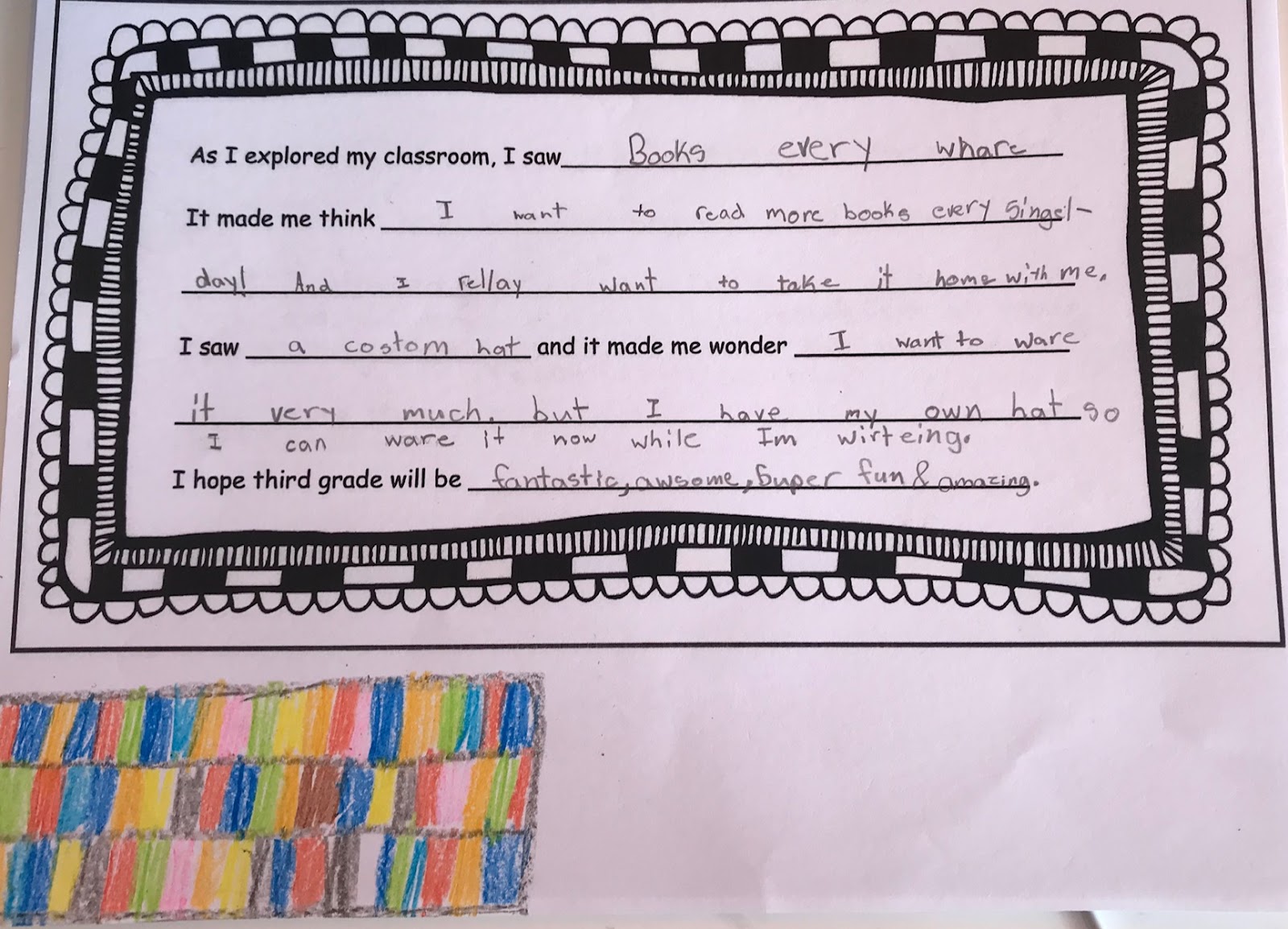
Once again, our first-day explorer kick-off was a hit.  The kids loved coming into the classroom to find their desks filled with explorer gear that they could put on immediately.  After exploring the classroom and completing their checklist, the students wrote about what they saw.  It was fun to read what they focused on during their exploration.


Anne and I also gave out three of our painted rocks!  The students' faces lit up like twinkling stars on a clear summer night when we announced their name!  They were shocked, but so proud of themselves.  One boy even said, "I'm going to keep this forever."  He received the "leader" rock. Another boy received the "thoughtful" rock, and a third boy received the "helpful" rock.  I know the kids loved them, but it made us feel even better to give them because they were so well deserved and unexpected.


Now we just need to incorporate a rock writing lesson or SEL lesson so we can use the rocks we bought from the science store.  In that lesson, each student will receive their own rock to write about and keep.  We will write about it here once we plan it.

We've decided to begin our math unit as an inquiry lesson about multiplication.  When we went to Teachers Pay Teachers to find vocabulary sorting cards for Eureka Math Grade Three Module One/Lesson One, we did not find exactly what we wanted.  What to do????  I made a set.  Anne is going to put them up for free in our TpT store incase the link I gave you does not work.  Before beginning the lesson, we are going to have our students get into groups of 3-4 and match the words as they see fit.  Then, they will watch a Module One/Lesson One video to learn about the lesson.  They will complete the homework page with a partner.  Then, after they have "played" with the concepts of that lesson, we will do the Problem Set together.  Hopefully, they will have a complete understanding of the concepts on that page, but if not I will fix any misunderstanding or confusion on the spot.  Finally, the kids will go back and correct any mistakes they made on the homework page they did independently.  Our goal is to have the students more engaged in the lesson for a longer period of time.  We have found that these long Eureka math lessons are an invitation for kids to "tune out."  We will let you know how it goes.


**As a side note, we have decided to not send home the homework pages from Eureka Math.  Instead we will send computation pages home so the students can meet the standard for memorizing all for operations up to 12.**

For Module One/Lesson 2, I have decided to begin with an activity called "Odd One Out."  That lesson focuses on rows, columns, and products.  I'm hoping this activity activates my students' thinking about those concepts.  I will also incorporate some of the lessons from Amy Lemons The Magic of Math Multiplication Grade 3.
Students decide which picture does not belong with the others.  They must have reasons to support their decision.

That's all I have for now.  I'm going to type up my plans for the week before enjoying the rest of my Labor Day.  I hope you all do the same.

Kim and Anne

Monday, July 29, 2019

Vivid Visualizations

Monday, July 29, 2019

Good morning!  I know, Anne and I haven't posted for months, and now I've posted twice in two days.  I think it's because I'm getting antsy for all things school and third grade.  I'm getting excited to get back into my classroom to clean and decorate. It's one of my favorite things to do. However, once I'm given the "okay" to go in, my days will be a whirlwind, so I wanted to take advantage of this calm moment to share some cool websites I learned about while taking a graduate literacy course this summer.

The course was called Activating Students' Creative Thinking Through Literacy ELA Grades K-5. I did not realize the rigor these concepts, theories and activities would provide for our students and us.  It is all very exciting.  Below is an excerpt from my final research paper that may give you some insight into the course objectives.

“If we teach today’s students as we did yesterday’s, we rob them of tomorrow.”

John Dewy

According to Module One’s foundation reading resource, activating students’ creativity is vital because it will aid educators in teaching students how to be flexible in their thinking, so when they encounter new situations they can solve problems in innovative ways.  We must explicitly teach our students to think creatively because they are going to be performing jobs and having careers that have not even been invented yet. We need to change our teaching so it matches what our students will face when they leave our classrooms. Now more than ever, we need to teach our students how to be creators and innovators, (Spencer, 2019).

“Creative Teaching and Teaching Creativity” (2018), as well as Module One’s foundation text, had similar definitions for the word creativity.  It is the “generation of a new product that is both novel and appropriate in a particular scenario.” Research has shown that creativity increases motivation, deepens understanding and helps students develop intrinsic rewards and enjoyment. These feelings lead to life-long learners, which is my ultimate goal as a teacher.  According to the article, implementing activities that promote creativity, help students make cross-curricular connections, which in turn deepens understanding.

To synthesize everything I learned in this course, I wrote a lesson plan that includes seven literacy activities that will give students opportunities to make their thinking visible and divergent. The lessons are designed to help  students move from the knowledge level of visualization to a deep understanding of this literacy strategy. Not only is the visualization reading strategy one of our favorites, we believe it is one of the more useful strategies our students can use to deepen their reading comprehension, as well as their love of reading.

You can find this entire lesson plan bundle on our TpT store.

Below is a website that explains this thinking strategy: See Think Wonder.  You can use this strategy with any lesson, however in this plan I use it with the Newsela article titled Sunglass Cat.

You can use this strategy with any text, too.  In my lesson plan I use it with Dog Breath: The Horrible Trouble with Hally Tosis by Dave Pilkey.


I cannot wait to use these lesson plans in the fall.  I'm most excited about my kick-off lesson.  Anne and I are going to dress up like movie directors complete with sunglasses, megaphone, beret, and clapboard.  This is because we teach visualization as making a movie in our minds.  The kids will all get a pair of movie star glasses, too, to use when we visualize various texts and genres.  This lesson plan bundle includes visualizing poems, music, fiction and non fiction texts.  At the end, the students must use their understanding of visualization to design an animal shelter.  It will be the first time we will incorporate a project-based activity when teaching reading strategies.

Below are some websites I found useful when researching how to activate my students' creativity.  We hope you find them helpful, as well.


I will try to post our first day scavenger hunt and our safari outfits we wear on the first day of school later this week.  Otherwise, Anne and I will post it when she gets back from vacation.

Have a great rest of your summer.
Kim