Sunday, February 9, 2020

Valentine's Day, SEL, and Math All Rolled Into One

Sunday, February 9, 2020

Just a quick post to share some Valentine fun.  Anne and I found a new Valentine candy-heart math activity to use with our students.  Most years, we give each student a box of conversation hearts and have them use the candy to practice graphing, comparing numbers with symbols, and division.  However, this year we decided to combine this new math activity with some SEL.  We wanted to have students work in groups of 4 knowing they may struggle with sharing and working together.  Candy does that. :)  So, before beginning the lesson, we had a class meeting to discuss some pluses (pros)  and some deltas (cons) about working together in a cooperative group.  We reviewed Habit #6 Synergize and Habit #4 Think Win Win.  Then, the students decided which delta they would be mindful of during the activity, and if they noticed it creeping up they would gently bring themselves back to synergizing and thinking win-win.   

We cannot believe this is free on TpT!  It's so good.

This bundle is perfect for our students because it involves gathering data in a tally table, creating line plots, finding fractions, determining probability, multiplying, dividing, finding the mean, median and mode, and a challenging word problem to solve.  There is something for students of all math levels to enjoy.

So proud of how well everyone worked together and cooperated.

Close-Up!

Everyone was focused, engaged, and having fun.

Thinking hard!


After we complete the activities on Monday, we told the students we would use the hearts to create a Valentines Day pin.  We do these each year and they are definitely a hit.

This one is a little old.  My newer one was eaten by someone I love dearly.  I'll leave it at that.  :))))

Other fun activities we will do this week include a Valentine logic puzzle, writing Valentine poems to our principal, and reading Love, Z and making an area robot.  Cannot wait for tomorrow.

Another freebie.

This frame is from the notsowimpyteacher blog.  I will change it to "I like you more than..."

This is an adorable book with a heart-felt message about love.

Below is one other area Valentine's Day activity we hope to do this week.


We want to now solve area and perimeter problems in the same lesson.


Happy Valentine's Day!
Kim and Anne

Sunday, February 2, 2020

Increasing Vocabulary Knowledge with One Word From Sophia

Sunday, February 2, 2020

Happy Groundhog Day!  From what I heard this morning, the groundhog saw his shadow.  Does this mean an early spring?  Anne and I certainly hope so.

Today we wanted to write a quick blog about a vocabulary activity we did with one of our reading groups.  It is a follow-up to our one-word goal we wrote after winter break.  We thought the adorable, yet challenging, book titled One Word From Sophia by Jim Averbeck would be perfect for building students' vocabularies.  Don't be fooled by the cover.  While it looks like it is for younger students, the plot and word choice is anything but that!

As the story evolves, Sophia goes from being too verbose to finding one perfect word to meet her goal.

Our students each had their own copy of the story.  We read and discussed the plot while being mindful to use strategies good readers use to comprehend at the deepest level.  As we read, we also recorded amazing words the author used, and tried to determine their meanings through context clues.  There are an abundance of Tier 2 and Tier 3 words in this book.

After reading, the students chose one of their identified words to learn more completely.  We did a 4-square activity--word, definition, sentence with the word, and synonyms of the word.  The end result is adorable, but more importantly the students have a new word that they are excited to use when speaking and writing!  They love them.

Here are just a few of the words the kids chose.  We identified well over 30 amazing words in this book!

The amazing word is in the first box.

The second box has the definition and part of speech.

The students wrote a sentence that included their new amazing word and a picture.
The words outside the boxes are synonyms of the amazing words.

The 4-square activity was just the beginning.  Tomorrow the kids will teach each other their chosen word.  Throughout the week we will do activities that will help them internalize the meanings of multiple words.  Activities such as word association, example non-example, and a game called Hit or Miss.  These activities can be found in Bringing Words To Life: Robust Vocabulary Instruction, but if you want just a quick glimpse of some vocabulary activities look up "Authentic, Engaging, and Fun Vocabulary Activities and Games," at TpT.


We will continue focusing on collecting amazing words from our reading and the world around us.  This week I will read The Word Collector by Peter Reynolds.  Anne and I will give the students a little pocket notebook and marker (yes, a gimick) to keep with them in case they need to write down a great word they notice.

Some years Anne and I have dressed up like "Word Wizards" and read this book.  The kids all wanted to earn a wizard wand by learning and applying as many amazing words to their writing and speaking as possible.  It's a fun way to engage the students who need a bit more than just the excitement of new words.
We hope you have an amazing week.  February is filled with fun activities, so take advantage of that to engage your students.

Kim and Anne


Sunday, January 12, 2020

Graphing Fun

Sunday, January 12, 2020

Wow, we cannot believe we are zooming into the middle of January already!  Our first week back was terrific--slow to get things finished--but terrific all the same.

We just wanted to quickly share a couple of graphing activities and programs we did with our math groups.  One of the end goals with my particular lesson, was to have my students teach Anne's students a new graphing program. Up until this point, my math group has not had the opportunity to be the "teachers."

Anne and I introduced our students to collecting data, making tally tables, and putting the information into bar graphs before winter break.  We showed the BrainPop Jr. video on graphs, and did an old Everyday Math graphing lesson.  The lesson was fun because it had to do with how many letters were in our first or last names.  We also introduced the students to analyzing the data to find the minimum and maximum numbers, range, median, and mode.  On a side note, there is a more advanced version of graphs in Brain Pop.


At that point, Anne's math group was then ready to generate questions and categories about favorite winter activities.  They collected data from their own math group, as well as from my math group.  They made their own tally tables to record the information they gathered, and they entered the information into  Google Sheets to create a bar graph.  Once the graphs were complete, groups of students analyzed the information wrote three statements about it.


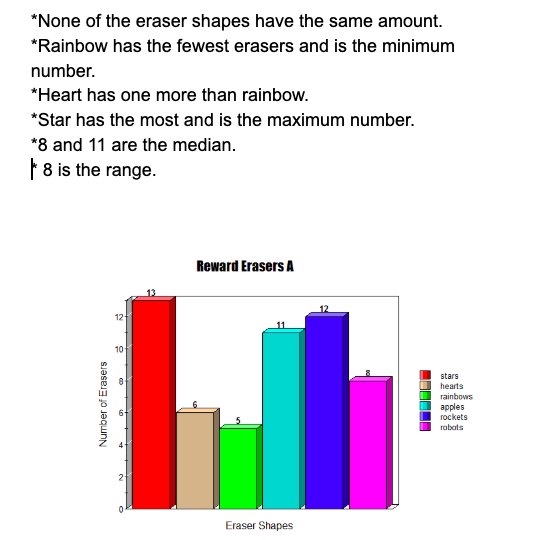
After winter break, I wanted to make my groups' graphing experience a bit more concrete.  As a whole class, we graphed how many of each Christmas-shaped eraser were in a bag.  We first made a tally chart so we could record our information. Then, we dumped the shapes onto the carpet. One by one the students took turns picking out an eraser from the pile, and we all recorded a tally in the correct column on our tally table.  The students were focused from the word "Go," because of the novelty of this math lesson, as well as the movement.

The students had more fun using the program Create A Graph, to enter the data and create a bar graph.  They loved choosing different colors for the bars and seeing the words and numbers morph into a graph!   Once the graphs were printed, we looked at the information and wrote statements about what we noticed, including the minimum and maximum numbers, range and median number.


Then it was time for the kids to do the exact same activity in small groups.  This time, the erasers were just a mix of various shapes.   Below are pictures.


This is one of the group's graphs from Create A Graph.


Friday, Anne's group of students taught my students how to generate a question and categories about winter, create a tally table, and survey the kids in the room.  Monday, my students will show Anne's students how to enter the information into Create A Graph, download it to their drive and print it.  Together, they will analyze their information.  I will add pictures to this post tomorrow night, as long as everything comes together as planned.

We will also show them two other videos we just found from Maths With Jacob.  I really like the graphing video because it gives a quick overview about different types of graphs.  As a morning warm-up, the students will answer questions about a line plot graph.  They will have learned about it from the video, and I took a screen shot of a line plot poster from A Math's Dictionary For Kids. This will give the students further information about line plots so they can complete the warm-up.


Created by Jenny Eather.


Knowing how much fun the next few days in math are going to be, Anne and I cannot wait for math time. Tuesday, we will begin our Snowman STEM activity that introduces/reviews 3-D shapes to the kids.


Have a great week!
Kim and Anne

Sunday, January 5, 2020

Happy New Year!

January 4, 2020

Happy New Year, everyone!  Hopefully you had a wonderfully relaxing holiday spent just the way you envisioned it for yourself.  Anne and I just wanted to share a few things we are going to do with our students on Tuesday.

The Curriculum Corner has January Welcome messages that are great to warm-up those brains when the students walk into the classroom. 


They also have cool Did You Know? January discussion cards.  They are great to read and discuss as we line up to go home. 


Anne and I found this Jack Prelutsky poem years ago and have been using it ever since.  We have the students read it and then work with a partner to answer questions.  This year I tweaked the questions a bit.  To get everyone in a celebratory mood, we buy New Year's Eve hats for the kids wear as they work. 


Reading  Squirrel's New Year's Resolution by Pat Miller was something we started last year.  This adorable story gives students a very tangible idea of what it means to have a New Year's resolution.


A new read aloud for us is One Word From Sophia by Jim Averback.  The story goes perfectly with one-word goal writing project we will do with our students.


We are combining two "one-word" ideas.  The first one comes from Thinker Builder.  It is called What's Your Word?  We will use the first page of his activity because it is a planning and brainstorming sheet. 


The writing project will come from One Little Word by Lindsay Flood.  In her activity, the students write their word, explain why they chose the word and write one way they will accomplish the goal in their personal life and one way they will accomplish their goal in their academic life.  Lastly, the student draw a picture of themselves trying to accomplish the goal.  We love that this inspires the students to visualize themselves meeting their goal.  Start with the end in mind, right?  Habit #2 will be discussed a lot during this lesson.  A cute twist on this idea is that Lindsay has the students write hashtag synonyms of their goal word. 


Here is my example.


Call me crazy, but if we have time, I thought I would have the kids watch one of the videos on making New Year's stars to decorate our bulletin board where these One-Word goals will be posted.


Anne and I did spend time revising lessons and putting them in our Teachers Pay Teachers store. 

Here's the link if you're interested in taking a peek.


Our link!

Lon Po Po is one of our favorite tales.  It connects with so many of our social studies and reading topics.  Our goal was to tap into students' creative and divergent thinking.  The activities very much do that, but the stand out is the interview the students write to portray the various perspectives of the wolf, the protagonist, and the reader.  They then record the interview in a podcast and publish it.  So fun!!!!

We wish everyone an exciting week back at school.  We cannot wait to see the kids and hear all about their time off.  Then, we can hit the ground running with fun learning and social emotional activities.

Kim and Anne

Sunday, December 8, 2019

Flying Reindeer? Nope! Flying Cups and Reindeer

Sunday, December 8, 2019

Good morning!

This post is going to be short and to the point.  We just wanted to share our Flying Cup Part 2 experiment.  Our students were super excited and engaged, once again, each afternoon last week.  Even when they were synthesizing their results from part 1 and part 2, as well as what they learned about forces, gravity and mass, to draw a conclusion about why their cup landed the way it did.  The discussions were lively and rich.  We wish we you could have heard them.

After discovering that the cup landed mostly on its side in part 1, the new challenge was to get the cup to mostly land on its top or bottom.  They only materials they could use were pennies (no more than 10) and something to attach the pennies to the cup.  They all chose masking tape; however, they could have chosen liquid glue, hot glue, scotch tape, duct tape, electrical tape, or pipe cleaners.

The set-up
Scientific method written in science notebooks

Group data
One group's design
Analyzing results to draw a conclusion and wrote a reflection.
This was a guided lesson because of the rigor of the writing task.

Only one team's cup landed mostly on its side.  They concluded, with the help of the class, that it was because they put the pennies around both the top outside rim and the bottom outside rim of the cup.  This added even more mass to the already heavy side of the cup.  Therefore, that is where it mostly landed.  Other groups loaded up the very bottom of the cup or the very top of the cup with pennies.  Since that allowed the top or bottom of the cup to have the most mass, that is where the cup landed mostly.

This group's landed mostly on its side, however they had a great argument for why they thought this would meet the challenge.  They thought putting the mass at both ends would guarantee that it land on either the top or bottom.

Not only did the reading on hyper doc assist in our students' learning, the Study Jam videos in this hyper doc did, as well.  The first and last videos were the most relevant to our lessons and experiments.  In fact, one student went home and wrote another journal entry with diagrams and labels about forces, acceleration and mass.  His mother was so impressed.  We are waiting for permission to share that entry with you.  Receiving that email early this morning made our Sunday even more special than it normal.

Next lesson--apply the concepts of force and motion and gravity and friction to robotics.


Another fun activity we did this week was our geometry reindeer.  This lesson was created by Amy Lemons.  You can find it on teachers pay teachers.  We wanted to take a break from 2-step problem solving and the distributive property in math.

Filled with activities.


One of our favorite activities and displays for the season.
Next week we are going to review 3-D shapes with a stem activity called Snowman Stretch.  We found the idea on the KT Feel-Good Teaching website and combined it with the What Did The Shape Say 3-D templates and speech bubbles.  We are looking forward to the thrilling sounds we will hear during math on Tuesday.  Pictures to come next week.

She has a TpT store, too.


We did not get to our scarecrow activities.  That will begin on Monday, so hopefully we will have pictures to share next weekend, in addition our snowman stretch pictures.  We are also in the middle of our Anansi the Spider cinquains.  We will share those activities along with a Christmas Spider legend and ornament next weekend.

Once again, we cannot wait to get back to school on Monday to dive into the fun activities we have planned for the kids.

Have a super week... only a few left before winter break.

Kim and Anne

PS: We began our morning warm-ups with these December Welcome Messages created by The Curriculum Corner.  The best part about them were the quotes at the top of the page.  Anne and I are trying so hard to convince the kids that mistakes and failures are good because it means they are learning something new, and the quotes this week happened to reinforce those messages from us.  check them out!